Authority travels with the action. Evidence travels separately.
Policy is set centrally. Each interaction carries bounded authority and is verified on arrival at the boundary it reaches. Nothing returns to the middle.
DECENTRALISED EXECUTION GOVERNANCE FOR AUTONOMOUS AI · NO CENTRAL GATEWAY
Policy stays central. Execution authority travels with the work. Mira lets you design, govern and run autonomous workflows across any model, agent framework, cloud or specialist intelligence, and verifies every interaction locally at the boundary it reaches, with evidence kept off the critical path.
Illustration: a planner agent fans work out to three agents in parallel. The credit agent delegates two checks: one asks an outside reasoning engine for a verdict, the other reads a protected banking system. The pricing agent tries to read every customer’s file in that system and is stopped at its boundary, while the other branches carry on and converge on an approval agent. Policy, trust and revocation sit above the workflow and are distributed ahead of time; no step calls back to them. Evidence of every decision drops separately into an audit vault below.
Works with any agent framework,
model or cloud. For example:
Most agent governance sends every consequential action through a gateway, or back to a central service for an answer. That puts one shared dependency in the critical path of every branch: fan-out becomes gateway load, and every join waits on the slowest round trip. MSEP, the protocol inside Mira, inverts it: bounded authority travels with each interaction, and the boundary it reaches verifies it locally.
Every action waits on a remote answer. If the service is slow or down, the work stops with it.
Every call funnels through one choke point, and that choke point holds the keys to every system behind it.
Authority is checked on arrival, beside the system being called. Nothing central sits in the path.
Centralise administration where it helps. Distribute execution authority where it matters.
Latency isn’t the whole argument. MSEP preserves the topology of the autonomous system itself, so governance follows the work as it fans out, delegates and reconverges, instead of forcing every branch back through the middle.
Policy is set centrally. Each interaction carries bounded authority and is verified on arrival at the boundary it reaches. Nothing returns to the middle.
Branches are verified at their own boundaries at the same time, so governance doesn’t serialise the work. About 0.57 ms per governed hop in pre-production; over a ten-hop chain in equal-work tests, 1.8 to 2.1 times sooner than an inline gateway and 2.2 to 3.0 times sooner than a central call-out.
There is no central service for every action to wait on. Routine decisions are made where the action lands, and evidence is sent separately, so it never holds up the work.
Governance means nothing if an agent can simply use another credential. Agents hold no standing keys to the systems they call: each boundary withholds the protected capability until the action is permitted.
A permitted action doesn’t make the workflow it creates permissible. Mira governs who may take part, what must come before what and how a run may recover, and seals the graph a run actually took beside the one it was allowed.
Where recovery is safe and defined, Mira restores trusted state and continues, with an approved substitute agent, model or provider where policy permits, rather than restarting the whole run.
An agent that forges or tampers with its authority is stopped and issued a Red Card, which signals actor-wide quarantine across your estate via SSF/CAEP. It constrains what that agent may do next until a named person reinstates it, so trust doesn’t reset when the workflow does.
Every decision at every boundary is sealed into verifiable causal evidence, sent apart from the action so it never slows it down. The payload stays in your own storage, and auditors can check the record without trusting Liora.
| Question | Gateway or central service | Mira boundary |
|---|---|---|
| Where authority is checked | In the middle, away from the action | At the system the action lands on |
| Across a multi-step workflow | Every step goes back through the middle | Authority travels with the work, bounded at each hop |
| Network traversals per action | 2 to 3 | 1 |
| Who holds system credentials | The gateway, for everything behind it | Each boundary, for its own system only |
| If the central service fails | Agent work stops | Routine decisions carry on |
| Decisions available | Allow or block | Six outcomes, from release to recover |
| Evidence | Logs at the checkpoint | A record anyone can verify, for every decision |
| Across parallel fan-out | Queues at the shared gateway; tail latency compounds | Verified concurrently at each branch boundary |
Pre-production measurements on our disclosed test environment, not production SLAs. Patent pending.
AI agents now approve payments, change production systems and move customer data. Most governance only finds out afterwards. Mira makes the decision before the action runs.
Knowing which agent acted doesn't prove that this action, on this system, was allowed at that moment.
Sending every action to a remote service adds delay, fragility and lock-in as workflows grow.
An audit trail explains what happened afterwards. You also need to stop the unsafe action, and prove the control you applied.
Mira makes the workflow governable; MSEP makes governance effective at each consequential execution boundary. This is what a boundary does each time an action arrives.
When an agent tries to pay, export, change or send something, the boundary checks it against your rules first. Then it allows it, removes private details, holds it for more authority, or stops it.
Names, birth dates and contact details are removed before they reach a model or vendor that shouldn't see them.
That authority can come from a named person, another trusted system or another source your policy defines. Nothing runs until it arrives, and a timer running out is never a yes.
Where recovery is safe and defined, Mira restores trusted state and continues on an approved alternative model or provider, rather than restarting the whole run.
Works with any agent framework, model or cloud, including agents you built yourself. Change a provider without rebuilding your controls.
Every run leaves a tamper-evident record of what was checked, decided and done, mapped to the regulations you answer to. Auditors can verify it for themselves, without having to trust us.
Risk, compliance and quality leads don’t need to write code. Describe the policy the way you would say it, link it to the regulation it comes from, and Mira compiles it into a deterministic boundary your agents cannot argue with.
The way you would put it to a colleague.
Each rule carries the regulation or policy clause it comes from.
Explicit rules you can read, test and sign off.
Nothing takes effect until an authorised person publishes it.
Do not send customer health information to an external model. If the classification is uncertain, a privacy officer decides.
interdictelevatePrivacy officerNothing improvises at runtime. A model can help you draft a rule. Only the compiled rule is ever enforced, the same way every time.
For risk, compliance and quality leads. Describe the policy, review the rules it produces, and sign off.
For process owners. Draw the workflow, choose which agents act on what, and mark where a person decides.
Wrap the agents you already run and govern every step. See the code
All three build the same rulebook, so a compliance lead and an engineer are always looking at the same rules.
Mira doesn’t try to be your sanctions screen, credit model or clinical engine. Plug in the one you already trust. It reasons and signs its verdict. Mira acts on that verdict, for that exact action, and nothing else.
Real screens from an example drug safety workspace, using synthetic data.
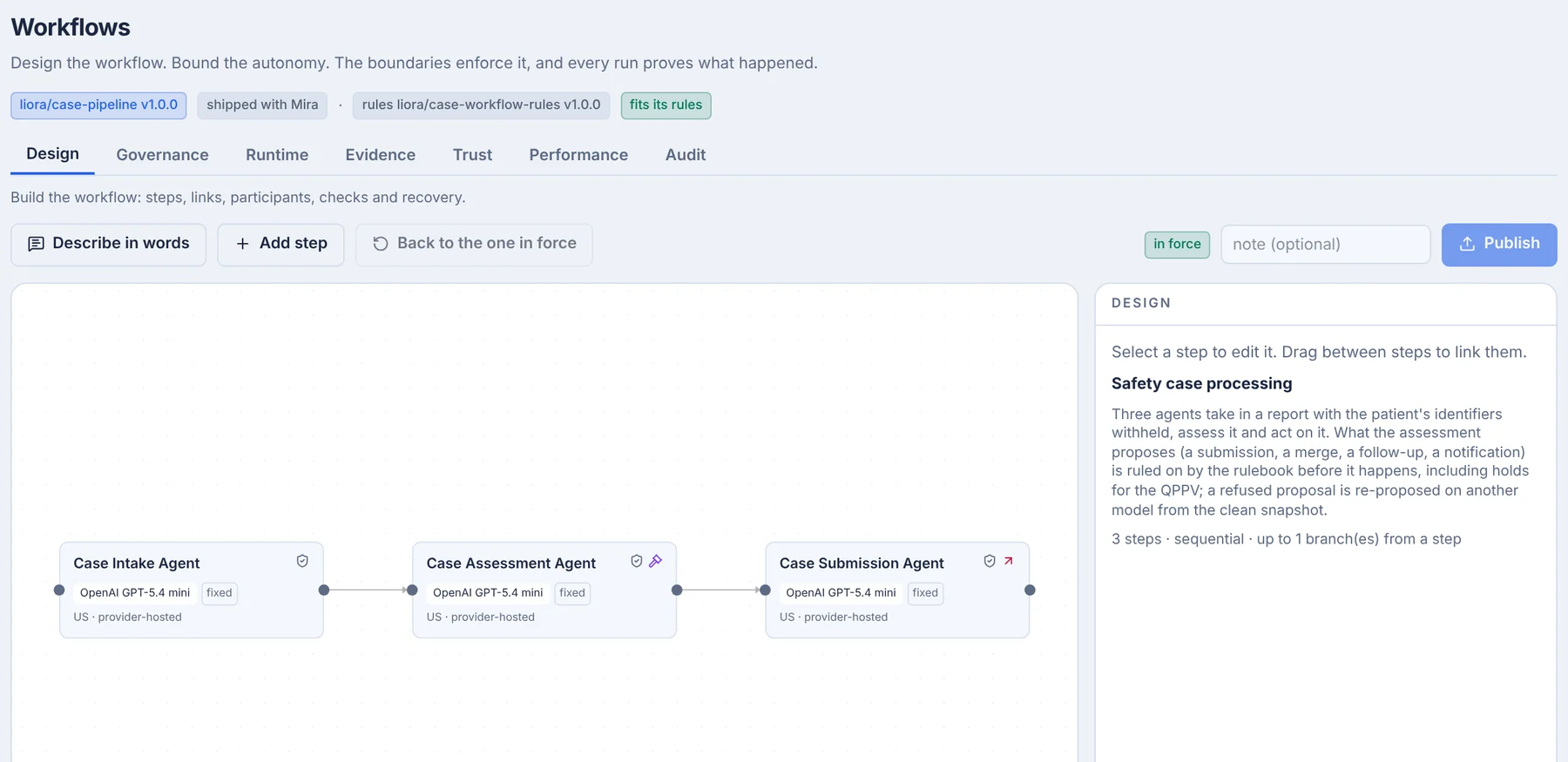
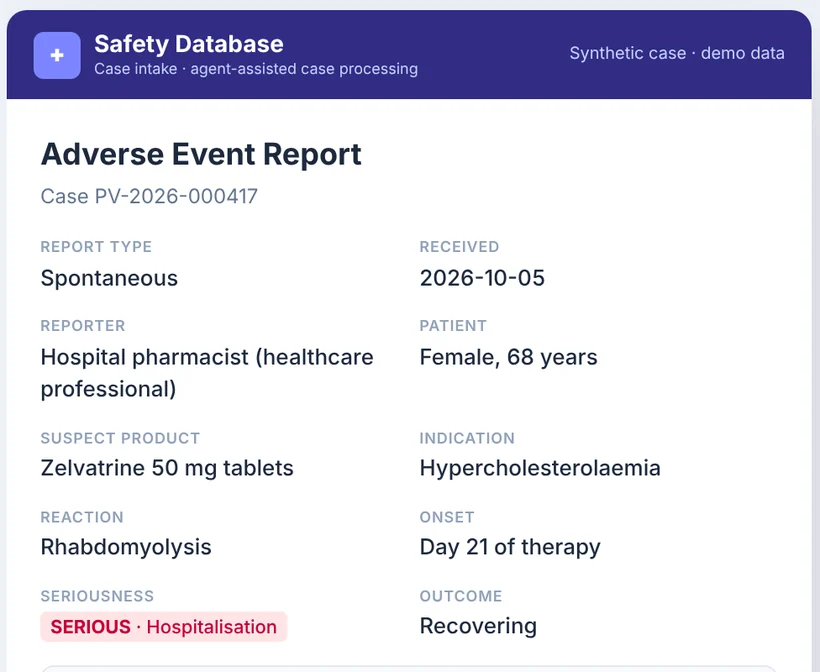
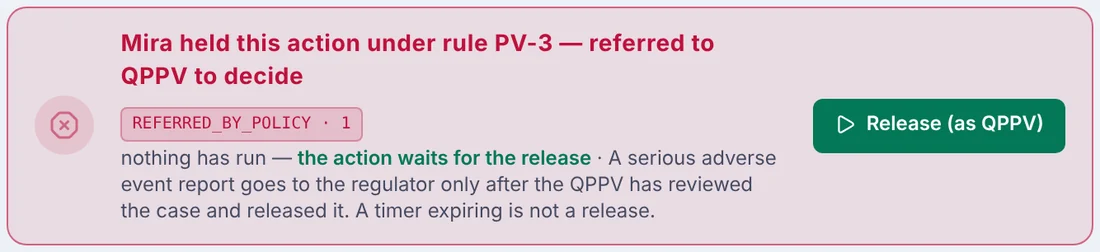
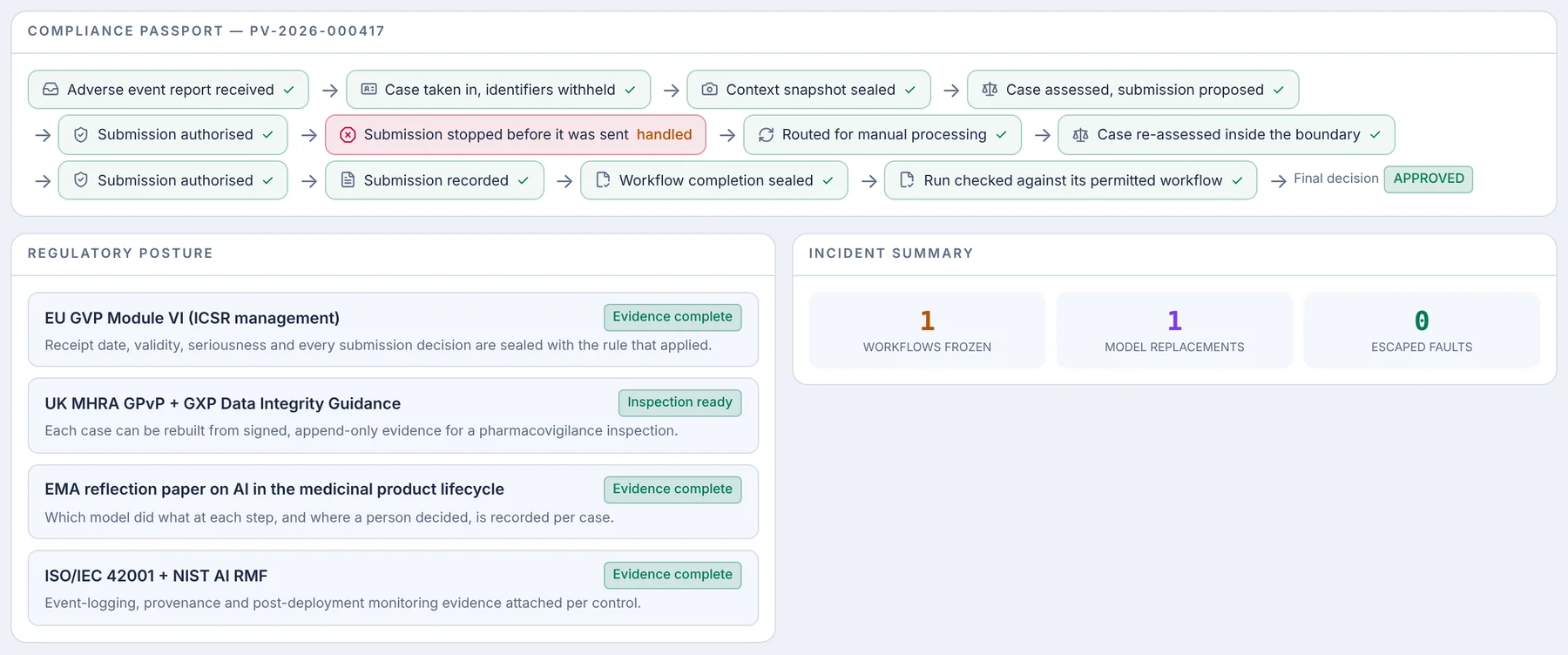
A credit-approval workflow where an agent leaks personal data mid-run. Switch Mira on to see what changes. One of 50+ scenarios in our demonstration build spanning banking, credit, pharma, healthcare, payments, software deployment, and more.
What Mira checks, what it stops, and the evidence it leaves. Plain English, captions on.
Security, risk and compliance leaders need controls they can explain to a board and evidence they can hand to an auditor.
Works across models, clouds and agent frameworks. Change a provider without rebuilding your controls.
Customer data stays under your control. Liora keeps the proof, not a copy of your data.
Consequential actions are checked against your rules before they happen, not explained after the fact.
Tamper-evident records that auditors can check for themselves, without having to trust Liora.
Open interfaces for the identity, policy and security tools your organisation already trusts.
Routine decisions don't wait on a central service, so a slow or failed dependency doesn't stop the business.
Full access to the Mira engine, plain-English rulebook builder, workflow designer and Audit Vault for development, sandboxes and client PoCs.
Consultancies and engineering teams keep 100% of the rulebooks and workflows they build.
A production licence applies when you go live. Full licence terms will be published with the developer release.
Mira is built and demonstrated. We are hardening it for production now, with design partners joining ahead of the developer release.
A working build showing governance, interdiction, recovery and verifiable evidence across agent workflows.
Independent benchmarking, security review, enterprise deployment tooling and framework integrations.
The Apache 2.0 SDK and the Always-Free Developer Licence: the Mira engine, plain-English rulebook builder, workflow designer and Audit Vault, free for development, sandboxes and client PoCs.
Policy management, assurance, reconstruction and sovereign deployment for consequential AI workloads.
Join the design-partner programme. Early partners help shape Mira and get first access to the platform and SDK.
Prefer email? hello@liora-ai.co
Tell us a little about what you're building. We'll be in touch before the developer release.
